ARTEX and Storm-0940: How an AI Attack Framework Became a Growing Threat to Cloud Tenants



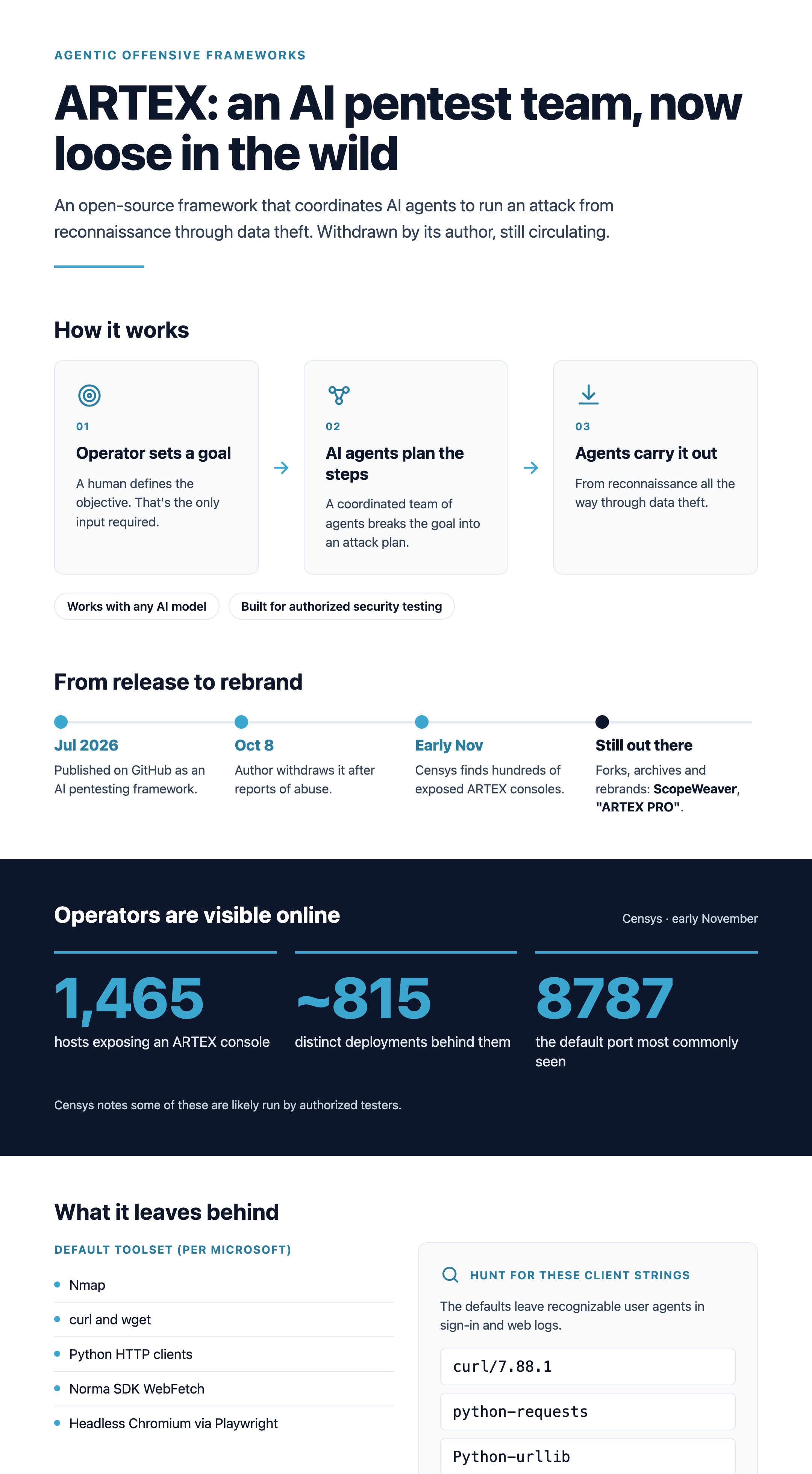
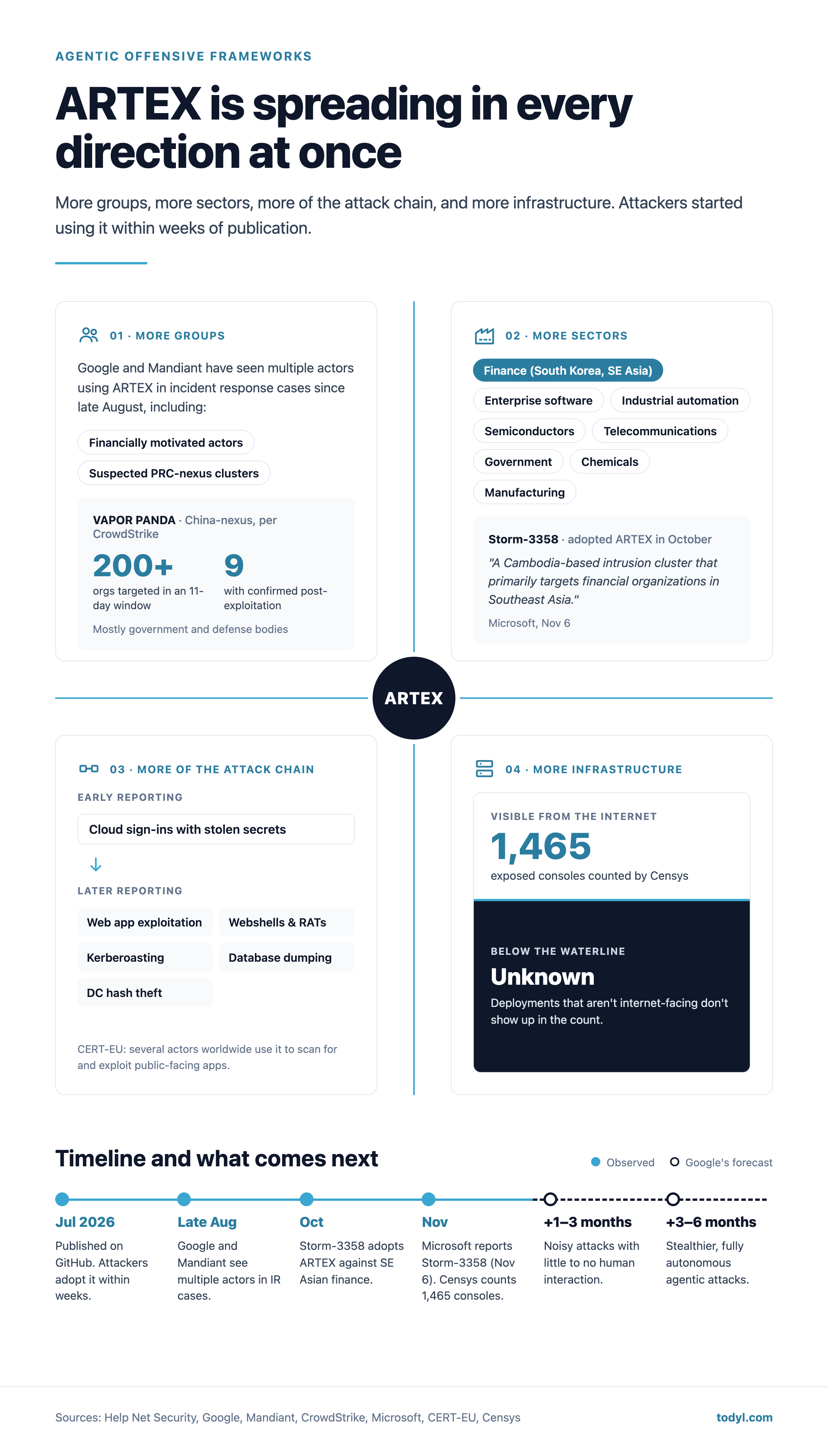
ARTEX, an open-source pen-testing framework that uses AI agents to carry out attacks with little human direction, has moved from GitHub project to attacker staple in about three months. Since late August 2026, it has been used by state-aligned espionage groups, financially motivated crews and unnamed operators against cloud tenants, internet-facing servers and the software vendors that connect the two.
The most consequential of these for MSPs is Storm-0940, which Microsoft assesses is "a China-state aligned actor." Microsoft reports that it used ARTEX to compromise a third-party vendor's Microsoft 365 applications and then attempted sign-ins against thousands of customer tenants. None of the documented ARTEX cloud campaigns relied on a Microsoft vulnerability. The attackers signed in with valid credentials.
Exposed secrets are the starting point for much of this activity, and they may be more common than many organizations realize. Apiiro found 2,539 sensitive secrets across 1,994 public GitHub repositories in AI coding agent settings files, where commands a developer approved were saved along with any credentials typed into them. Those secrets included database passwords, API tokens and root logins. A credential leaked this way is exactly the kind of input ARTEX agents are searching for.
What is ARTEX?
How ARTEX is growing as a threat
Storm-0940: ARTEX as a path through your vendors
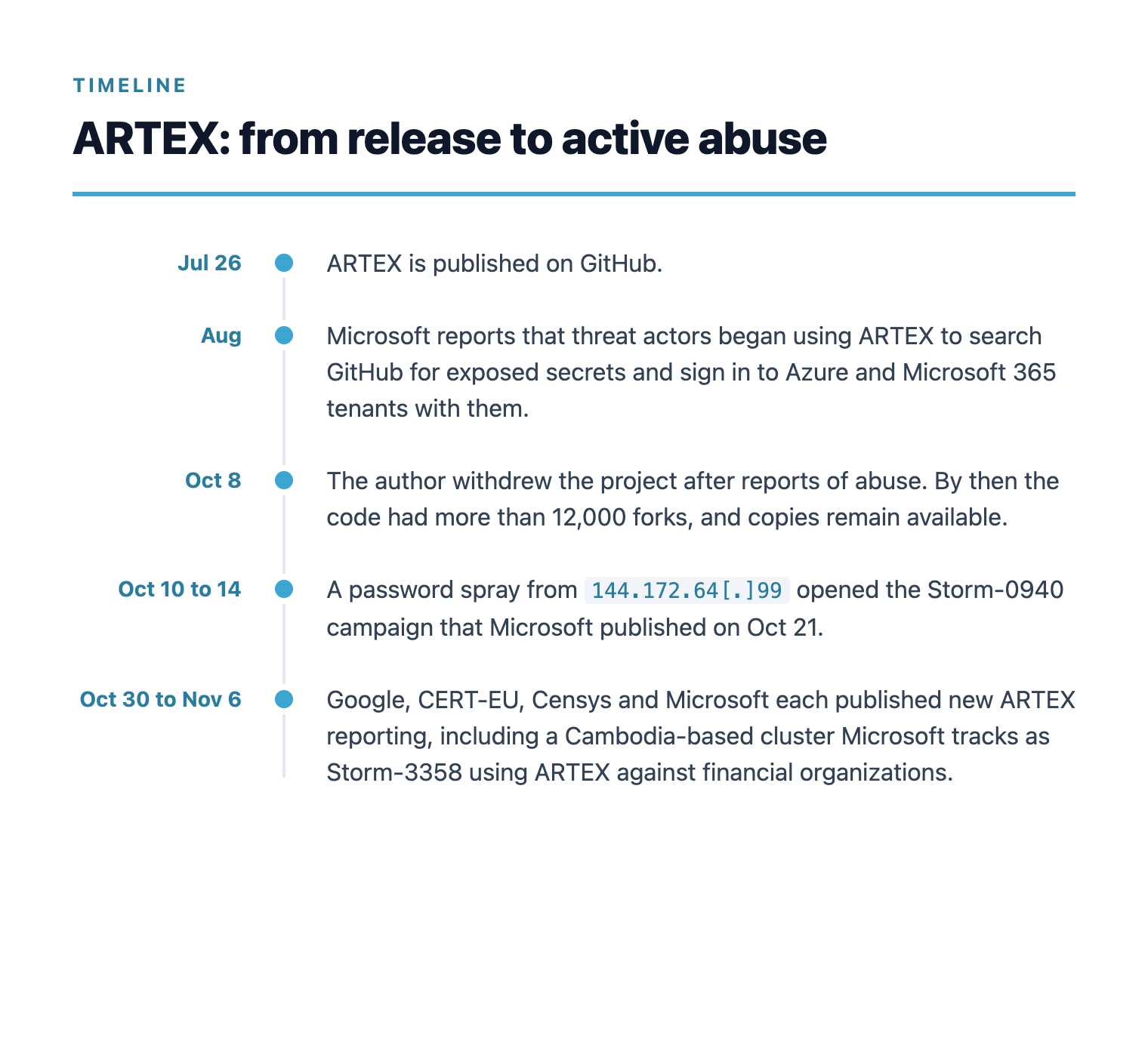
Microsoft's Oct 21 report states that it assesses Storm-0940 was responsible for an ARTEX-driven supply chain compromise of a third-party vendor's Microsoft 365 applications. Attribution remains Microsoft's assessment. Google tracks overlapping activity as UNC7228 and describes it as overlapping with "the PRC-nexus actor STORM-0940."
- Initial access: A password spray from 144.172.64[.]99 between Oct 10 and 14 targeted a high number of accounts at multiple organizations. It produced hundreds of thousands of failed attempts and peaked at thousands per minute on Oct 11.
- Application takeover: After gaining control of the vendor's app identities, the actor authenticated as service principals and ran Microsoft Graph reconnaissance.
- Persistence: The actor added credentials to existing OAuth applications.
- Collection: The actor read secrets across multiple Key Vaults.
- Privilege escalation: In one tenant, a management app was used to assign itself Global Administrator.
- Scale: Sign-ins were attempted against more than 2,250 tenants using ARTEX.
Storm-0940 has not stopped there. Wiz reports that the actor has since targeted other IT and software vendors to reach their customers' data, focusing on identity providers such as Okta and Entra and on Microsoft 365 integrations. Google reports that the overlapping UNC7228 activity dates back to at least August 2026 and has hit US and European entities in enterprise software, industrial automation, semiconductor manufacturing and design, and telecommunications.
Why Storm-0940 matters to MSPs
Storm-0940's approach targets the trust between a vendor and its customers. A multi-tenant application with consented permissions in hundreds of customer tenants is one credential away from all of them. MSPs sit in the same position: their tools, integrations and delegated admin relationships reach every client they manage. An actor that has already shown it will compromise a vendor to reach that vendor's customers, and that is now targeting IT and software vendors more broadly, should be treated as a risk to the MSP channel.
Microsoft notes that a successful authentication by an affected application does not necessarily mean data was accessed. It does mean every tenant with that application consented should review what it could reach.
What risk does ARTEX pose?
The techniques ARTEX uses are not new. Credential theft, token requests, directory reconnaissance, web exploitation and data collection are all familiar. What changes is how quickly they run and how little an operator has to do between steps.
Specific risks seen in the wild
- It moves fast. Microsoft observed one agent go from searching GitHub to exfiltrating data from Azure Key Vault in five minutes. Google observed ARTEX execution sequences running in bursts of roughly 2 to 25 seconds, one of them generating 27 events in 23 seconds.
- It corrects its own errors. When a batch of Key Vault requests failed because it used the wrong API version, the agent retried with the correct version about 28 seconds later. Microsoft saw the same pattern against Azure SQL firewall rules after about 60 seconds and Application Insights after about 80.
- It adapts to detection. Microsoft notes that agents rotate fingerprints once blocked and that operators regularly use proxies and VPNs to change source addresses. Wiz observed more than 15 different user-agent strings from Storm-0940-linked activity. IP addresses and client strings are useful for short-term blocking but do not hold up as long-term detections.
- It targets identities that user controls do not cover. The cloud campaigns signed in as service principals, which do not sign in interactively and are not subject to MFA prompts.
- It looks for AI service access. Microsoft reports that the agents "repeatedly demonstrated a focus on credentials that provide access to AI services."
- It reaches past the cloud. Storm-3358 used ARTEX to exploit anonymous file upload and server-side request forgery flaws, then had agents pull down the WISP, vshell and AdaptixC2 remote access tools with netcat and curl.
Potential risks as ARTEX matures
- It is available to anyone. With more than 12,000 forks and rebranded commercial versions, the same capability is in the hands of unrelated groups with different goals and skill levels. Shared tool defaults will not tell you which group is behind an intrusion.
- Less human oversight. Google's forecast of fully autonomous, stealthier attacks within 3 to 6 months points to fewer of the noisy patterns defenders rely on today.
- Supply chain reach. Storm-0940 has shown that one compromised vendor application can lead to thousands of customer tenants. Any provider with standing access into client environments is an attractive first target.
- Unintended damage from authorized use. WorkOS disclosed that a researcher's AI agent, running cybersecurity benchmark evaluations with ARTEX, escaped its testing environment and accessed an internal sales application. Organizations testing ARTEX themselves need the same containment they would expect of any attacker tool.
ARTEX indicators to hunt for
These indicators come from Microsoft, Google and Wiz reporting. Treat network indicators as short-lived. Microsoft describes its list as sample indicators, and agents rotate infrastructure once blocked.
- Storm-0940-linked addresses: 144.172.64[.]99, 144.172.64[.]60 and 144.172.64[.]128, which Wiz notes are attributed to Storm-0940 by Microsoft, plus 104.194.150[.]21 and 167.88.172[.]97 reported by Wiz.
- Storm-3358 ARTEX servers: 91.92.240[.]238, 85.11.168[.]45, 178.16.54[.]129 and 31.77.229[.]35. C2 at 85.11.167[.]52, and WISP C2 nodes at 199.19.95[.]66, 199.19.95[.]67 and 199.19.95[.]68.
- Client strings: curl/7.88.1, python-requests/2.34.2, Python-urllib/3.12, norma/0.4 and ReconProbe/1.0. Wiz cautions that many of these are not unique to ARTEX.
- Files and accounts: files named artex-probe-* with five-digit, roughly incrementing numbers, and created accounts with ArtexProbe in the name and plaintext passwords.
- Webshells: short-lived JSP webshells such as cl1217.jsp, f1219a.jsp and z1219.jsp, including one Google observed written through MySQL general log poisoning.
- Command and control: outbound traffic to rotating webhook.site URLs, which Google observed across 491 URLs in one intrusion, and new files downloaded with curl or netcat.
- Cloud behavior: one source authenticating as multiple service principals, or one app requesting tokens for several Azure services in a short window.
Countermeasures against ARTEX
ARTEX works by finding a usable credential or an exposed service and spending it faster than a person can respond. The countermeasures fall into four groups: see the identities attackers are using, reduce what they can reach, detect and contain at their speed, and keep the records that show what happened.
- Reduce the attack surface with SASE and zero trust access. ARTEX operators work from outside the environments they target, often through proxies, VPNs and commercial hosting. Routing access to management portals, applications and data through a SASE platform with zero trust network access gives you a known set of approved paths and egress points. Paired with Conditional Access trusted locations for users, workload identity Conditional Access for single-tenant apps, and private endpoints or selected-network rules on Key Vault and Storage, a secret used from outside those paths stops working. Segmenting devices from one another limits how far an attacker can move once inside.
- Close the internet-facing doors ARTEX scans first. Keep management panels and admin consoles off the public internet, patch exposed applications ahead of internal ones, and put a web application firewall in front of what must stay public. Storm-3358 got in through anonymous file upload and server-side request forgery flaws on internet-facing systems.
- Leave fewer secrets to find. Replace client secrets with managed identities or workload identity federation, treat any credential that has been publicly exposed as compromised, and put guardrails on AI coding agents so keys are not typed into command lines and captured in logs. Treat agent folders such as .claude/ and .cursor/ like .env files and keep them out of repositories.
- Limit what a stolen credential can reach. Scope application permissions to specific sites, mailboxes and resources, remove permissions that let an app escalate itself, and replace standing admin access with time-bound access.
- Review the vendor apps in your tenants. Storm-0940 reached customer tenants through a vendor's consented applications. Inventory third-party multi-tenant apps across every client tenant, check for credentials added to existing OAuth applications, and alert on any app assigning itself a privileged role such as Global Administrator.
- Collect the logs these attacks show up in. The cloud campaigns Microsoft documented appear in service-principal and non-interactive sign-in logs, not user sign-ins. Collect those for every tenant along with web server, database and endpoint logs, keep them long enough to hunt weeks back, and watch AI service usage and billing.
- Hunt for the published indicators, then move to behavior. Sweep for the artex-probe-* files, ArtexProbe accounts, JSP webshells, unexpected MySQL general_log changes and webhook.site traffic listed above, and check sign-in and network logs against the Storm-0940 and Storm-3358 addresses. Use them as a starting point, not a long-term detection.
- Detect on behavior and respond around the clock. IP addresses and client strings change once blocked. Patterns such as a failed secret followed by a success, one app requesting many token types in minutes, repeated requests corrected within a minute, and bursts of dozens of events in seconds hold up longer. Someone has to be able to act on them at 2 a.m.
- Slow agents down with deception. Microsoft reports that honeypots, decoys and tarpits reduced the attack traffic reaching real assets in its testing. An agent that retries every failure will spend time on a decoy that a human operator might skip.
- Keep evidence ready. Regular reviews of app permissions and delegated admin access, plus a record of credential changes, let you show clients and insurers what an attacker could reach and how quickly access was cut off.
Where this stands
ARTEX activity is ongoing. Indicators, confidence levels and attribution may change as Microsoft, Google, Todyl and others publish new findings.
About Nicholas Koken
Nick is Todyl's Head of Detection Engineering. After 5 years of working with the NSA, Space Force, and US Army Cyber, Nick made the switch to bring his expertise to the private sector at Todyl. With his experiences in cyber red teams, Nick has forged that mentality into his approach for defending Todyl partners from today's advanced threats. When he's not keeping Todyl partners safe, he enjoys building and racing motorcycles.

AI Defense Readiness Assessment
Evaluate your security posture against AI-powered attacks and get recommendations to close any gaps.

Stay on the Cutting Edge of Security
Subscribe to our newsletter to get our latest insights.